Step through a small example
The interactive PE explorer explains operand movement and partial sums. It is a teaching model, distinct from recorded RTL evidence.
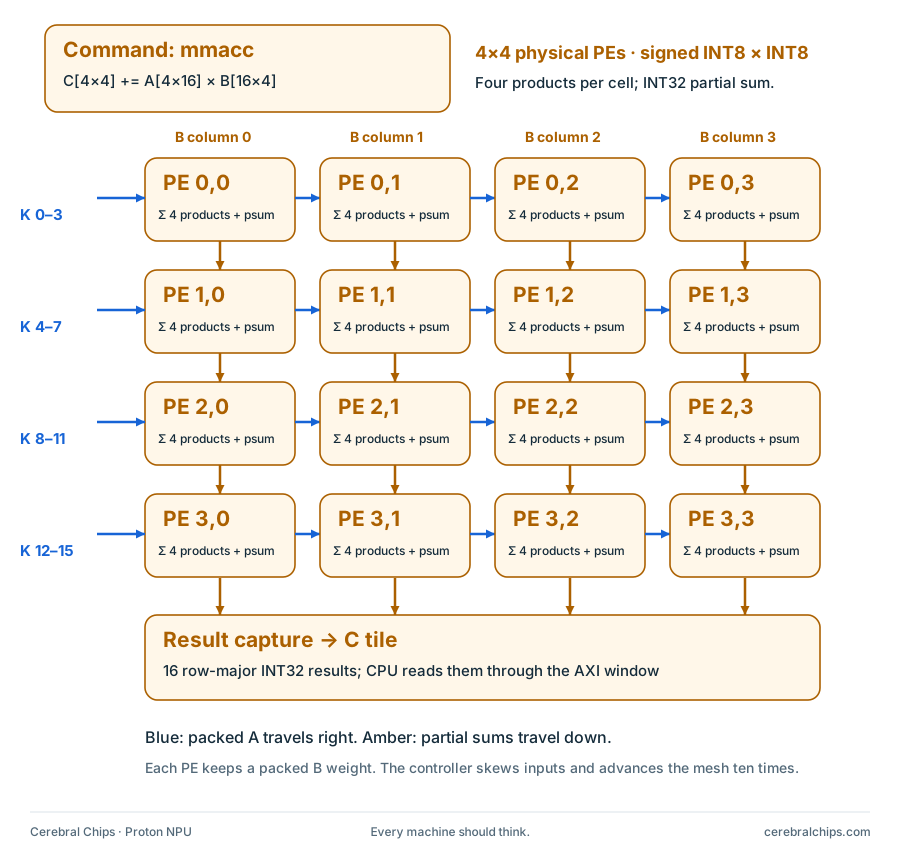
Open PE explorer →Sixteen processing elements compute small tiles, while a C library assembles those tiles into larger matrix products.
The engine combines open-source integer compute RTL with our tile buffers, scheduling controller, AXI target and custom command path. Each PE computes a packed dot product of four signed byte pairs and adds an INT32 partial sum.
| Property | Current implementation |
|---|---|
| Array | 4 × 4 = 16 physical PEs |
| Per PE | Four INT8 products + INT32 accumulation |
| Operation | C[4][4] += A[4][16] × transpose(BT[4][16]) |
| Storage | A: 64 bytes; BT: 64 bytes; C: 64 bytes |
| Output layout | Row-major INT32, modulo 2^32 |
| Scheduling | 10 mesh advances, then final capture; 12 observed issue-to-done cycles |
| mzero | Clear all sixteen C values |
| mmacc | Accumulate one K=16 tile; return scalar status 0 |
| Larger dimensions | C library tiles M/N by 4 and K by 16; zero-pads incomplete tiles |
The CPU writes operands to the uncached AXI window at 0xE0000000. A starts at offset 0x100, BT at 0x140, and C at 0x180. The engine performs no DMA. Software copies results back to ordinary RAM for subsequent scalar or RVV work.
.insn r 0x2b, 0, 0, rd, x0, x0   # mzero
.insn r 0x2b, 0, 1, rd, x0, x0   # mmacc
LLVM’s assembler already supports .insn, so the application needs no compiler modification. The hardware recognizes these two encodings; reserved encodings trap. This is a custom ISA contract.
The interactive PE explorer explains operand movement and partial sums. It is a teaching model, distinct from recorded RTL evidence.
Open PE explorer →The matrix-wave command produces FST, a compact VCD and per-command arithmetic checks from real simulation signals.
Waveform commands ↗